Article
The Different Pronunciations of the Letter ‘A’ in the St Basil Liturgy According to the Coptic Tradition
Michael Y Henein *, Shereen S Azer, Ahmes L Pahor, and Nabil S Isshak
The European Academy for Coptic Heritage - TEACH, London, UK
Abstract: The history documents significant decline in the use of Coptic language commenced on the 7th century onwards for various political and historical reasons. This resulted in significant loss of some of its original pronunciations and authentic linguistic styles, particularly with the surrounding influence of the Arabic language. This study investigates the pattern of pronunciation of the letter ‘A’ in the St Basil Liturgy according to the Coptic rite. It seems that the default pronunciation of the Coptic letter ‘A’ is the ‘A’ as in the word “car” in UK English. Even when searching the words in which it is pronounced ‘a’, we found that 89% of the words were ‘e;ouab’’ suggesting that it is likely to be a cultural development rather than following any standardized linguistic or grammatical pattern. This is further supported by the remaining four words in which the ‘A’ is pronounced as ‘a’, all of which are of Greek origin in which ‘A’ should be the correct pronunciation. Again, this claim is further supported by the four Original Greek words in which the ‘A ’ is pronounced ‘a’. In summary then, it seems that the default pronunciation of the Coptic letter ‘A’ in the St Basil liturgy should be ‘A’.
French
L'histoire relate un déclin significatif de l'usage de la langue copte à partir du 7ème siècle, pour diverses raisons politiques et historiques. Il en a résulté une disparition notable de certaines prononciations d'origine, et de styles linguistiques authentiques, en particulier avec l'influence de la langue arabe ambiante.
Cette étude explore les modèles de prononciation de la lettre copte “A” dans la liturgie de St Basile selon le rite copte. Il semble que la prononciation par défaut de la lettre copte “a” soit le “A”. En recherchant les mots où elle est prononcée “è”, nous avons trouvé que 89% de ces mots étaient “ⲉⲑⲟⲩⲁⲃ” ce qui sugg" èrerait qu'il s'agit vraisemblablement d'un développement culturel plutôt que l'application d'un modèle linguistique ou grammatical standardisé.
Cela est confirmé par les 4 mots restants où le “A” est prononcé “è”, qui sont tous d'origine grecque, où la prononciation correcte est “A”. Encore une fois, cette revendication est confirmée par les 4 mots d'origine grecque où le “A” est prononcé “è”. En résumé donc, il semble que la prononciation par défaut de la lettre copte “A” dans la liturgie de St Basile devrait être “A”.
German
Die Geschichte dokumentiert einen deutlichen Rückgang des Gebrauchs der koptischen Sprache, der im 7. Jahrhundert aus verschiedenen politischen und historischen Gründen begann. Dies führte zu einem bedeutenden Verlust einiger ursprünglicher Aussprachen und authentischer Sprachstile, insbesondere durch den Einfluss der arabischen Sprache.
In dieser Studie wird die Aussprache des Buchstabens “A” in der Basilius-Liturgie gemäß dem koptischen Ritus untersucht. Es scheint, dass die Standardaussprache des koptischen Buchstabens “A” das “A” ist, wie es in dem Wort “car” im britischen Englisch vorkommt. Selbst bei der Suche nach den Wörtern, in denen er als “a” ausgesprochen wird, fanden wir, dass 89 % der Wörter “e;ouab' “ lauteten, was darauf hindeutet, dass es sich wahrscheinlich um eine kulturelle Entwicklung handelt und nicht um ein standardisiertes sprachliches oder grammatikalisches Muster. Dies wird auch durch die verbleibenden 4 Wörter bestätigt, in denen das “ A” als “a” ausgesprochen wird, die alle griechischen Ursprungs sind und in denen “A” die korrekte Aussprache sein sollte. Auch diese Behauptung wird durch die 4 ursprünglich griechischen Wörter, in denen das “A” als “a” ausgesprochen wird, untermauert. Zusammenfassend lässt sich also sagen, dass die Standardaussprache des koptischen Buchstabens “A” in der Basilius-Liturgie “A” sein sollte.
Italian
La storia documenta un declino significativo nell’uso della lingua copta a partire dal VII secolo dovuto a diverse ragioni politiche e storiche. Questo ha provocato la perdita significativa di alcune delle sue pronunce originali e di stili linguistici autentici, in particolare con l’influenza della lingua che la circondava. Questo studio esamina l’andamento della pronuncia della lettera ‘A’ nella liturgia di San Basilio secondo il rito copto. Sembra che la pronuncia standard della lettera ‘A’ sia quella della ‘A’ nella parola ‘Car’ nell’inglese britannico. Anche durante la ricerca delle parole in cui è pronunciata “a”, abbiamo scoperto che l’89% delle parole era “e;ouab’, da qui ipotizziamo che è probabile che sia uno sviluppo culturale piuttosto che segua qualche modello linguistico o grammaticale standardizzato. Ciò è ulteriormente supportato dalle restanti quattro parole in cui la ‘A’ è pronunciata “a”, tutte di origine greca in cui la ‘A’ dovrebbe essere la pronuncia corretta. Ancora, questa affermazione è ulteriormente supportata dalle quattro parole di origine greca in cui la ‘A’ è pronunciata “a”. In sintesi, quindi, sembra che la pronuncia standard della lettera copta, nella liturgia di San Basilio, dovrebbe essere ‘A’.
How to cite: Henein, M.Y.; Azer, S.S.; Pahor, A.L.; Isshak, N.S. The Different Pronunciations of the Letter ‘A’ in the St Basil Liturgy According to the Coptic Tradition. TEACH J. Christ. Stud., 2022, 2: e11, doi: 10.56877/teach-jcs.2022.11.
Copyright: © 2022 Copyright by Authors. Licensed as an open access publication under the terms and conditions of the Creative Commons Attribution CC BY 4.0 license.
Submitted: 9 December 2021, accepted: 28 February 2022, published: 11 April 2022
Competing interests and funding: The authors have no conflict of interest to declare. The authors also agree to abide by the requirements of the ‘Statement of publishing ethics of the TEACH-Journal of Christian Studies (JCS)’ [17].
*Corresponding author: michael.henein@teach.eu.com
Introduction
The Coptic Church liturgies that are currently practiced are three in number including St Basil’s, St Gregory’s and St Cyril’s (initially described as St Mark’s Liturgy) [1]. The St Basil liturgy is the most commonly used, probably because it is the shortest liturgy compared to the other two liturgies [2]. While the order of the prayers’ segments for both St Basil and St Gregory liturgies is very similar, that of St Cyril is to some extent different, whereby the order of the prayers is not aligned in the same sequence. This may present another reason to support the common daily usage of St Basil’s liturgy. Despite the lyrics of the liturgies being translated to Coptic from the original predominantly Greek language, the Coptic church has maintained few commonly used Greek words and phrases, for example, agioc o :eoc - agios o Theos, iryny paci— - Irini pasi, ... etc. [3]. We have recently published the lyrics and music analysis of the St Basil liturgy and have shown that the two most important parts of the St Basil liturgy in which the priest requests full attention of the congregation, are the beginning of the Anaphora ‘O Kurioc meta pantwn umwn— - O Kyrios meta pandon eemon’ and the sacrament declaration at the very end of the liturgy, just before the distribution of the Holy Communion ‘Cwma agion ke ema timion - Soma agion ke Ima teemion ... ’. Those prayers are chanted in the Greek language in order to alert the congregation, using the common literary language at the time [4,5] (which was Greek), and to direct their attention to the importance and seriousness of those moments [6]. Other than that, the whole liturgy lyrics of the priest prayers are chanted in the Coptic language. It is interesting to note, however, that the deacon responses are mostly recited in the Greek language, probably for the same reason in an attempt to call onto the general congregation in the language they predominantly understand, to pray for a multitude of causes including the peace of the church, clergy, peace of the world, etc. [7]. Likewise, most congregational responses are in Greek for the same reason above.
Although the Coptic language was strongly practiced in Egypt in the first millennium of our Lord’s era, the subsequent centuries witnessed significant decline in its use due to various political and historical reasons [8]. This resulted in significant loss of some of its original pronunciations and authentic linguistic styles, particularly with the surrounding influence of the Arabic language [9]. One of the features of such loss is the current controversial opinions about the pronunciation of the letter ‘A- A’ which could have two main different forms (i.e., the ‘A’ and the ‘a’) similar to the use of the letter ‘A’ in the word ‘ask’ when pronounced in the United Kingdom as ‘A’ and when the same word is pronounced in the United States as ‘a’. This issue is important, because if ignored it may lead to a false impression of the opposite meaning of some commonly used words in the Coptic liturgy, such as in e;ouab and a;ouab, with the former meaning ‘holy’ and the latter quite the opposite [10].
The aim of this study was to assess the frequency of pronouncing the ‘A’ as ‘A’ versus ‘a’ in the St Basil liturgy according to the Coptic tradition.
Methods
The issue of the letter ‘A’ in the Coptic pronunciation was raised during an oral discussion on different ways of pronouncing the letter ‘A’ in Coptic hymnology and in different hymns. MH suggested checking the pattern of pronouncing the vowel ‘A’ in the St Basil liturgy as a good reference. He searched carefully the frequency of pronouncing the letter ‘A’ as ‘A’ versus ‘a’ in the St Basil liturgy using the Holy Euchologion printed by the “Al Moharaq” monastery and chanted by the Choir of the High Institute of Coptic Studies. Having focused only on the priest chants in the Coptic language, while disregarding the deacons and congregation responses which are predominantly in Greek, he ended up with a near accurate assessment of the use of the two main forms of pronunciation in the St Basil Liturgy. He also excluded all names in the “Commemoration of the Saints” prayer, which are known to be of Greek origin (referred to as Copto-Greek words). He then classified the findings according to the different prayers based on their order in the liturgy and tabulated the use of the two pronunciations in the pure Coptic words and Copto-Greek words.
Results
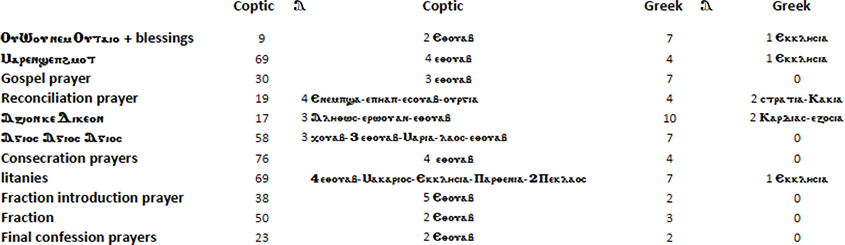
The table below displays the structure of the liturgy prayers in the first column (far left) and the number of times the ‘A’ is pronounced as ‘A’ versus ‘a’ in Coptic words and in Greek words.
The total number of the pronounced ‘A’ was 517 out of 561, making it 92%. The total number of the pronounced ‘A’ in the Coptic words only, after excluding the Greek words, was 458 out of 494, making it 93%. The number of the pronounced ‘A’ in the originally Greek words was 59 out of 66, making it 89%. Critical analysis of Coptic words in which the ‘A’ is pronounced ‘a’ showed that 33 of the 37 words are mainly Coptic ‘ouab’. The remaining two words were ‘Aly;oc, erwou-an, Par;enia, and Maria’. Three out of those four words were Copto-Greek, and two of them have two alphas with the first pronounced ‘A’ and the second ‘a’ being preceded by the letter ‘i’.
Discussion
It seems that the default pronunciation of the Coptic letter ‘A’ is the ‘A’ as in the word “car” in UK English. Even when searching the words in which it is pronounced ‘a’, we found that 89% of the words were “e;ouab’ suggesting that it is likely to be a cultural development rather than following any standardized linguistic or grammatical pattern. This is further supported by the remaining four words in which the ‘A’ is pronounced as ‘a’, all of which are of Greek origin in which ‘A’ should be the correct pronunciation. Again, this claim is further supported by the four Original Greek words in which the ‘A’ is pronounced ‘a’. In summary then, it seems that the default pronunciation of the Coptic letter ‘A’ in the St Basil liturgy should be ‘A’.
In the very few words which have two ‘A’, such as for example Maria, we noticed that, while the first letter is pronounced ‘A’, the second one is pronounced ‘a’, despite being Greek in origin and the two letters are similarly pronounced ‘A’ in the Greek tradition. This observation could be interpreted in two ways: Firstly, being preceded by ‘i’ as in ‘ia’ makes it softer and perhaps suits the cultural familiar sounds. Secondly, it highlights the impact of using long Coptic melodies, when sung, on the second ‘A’ and, again, singing it as ‘a’ makes it easier and more comfortable to the singer to produce the desired melody. This issue has previously been discussed in detail in another article investigating the sudden noticeable change from ‘A’ to ‘a’ in the same letter of the same word ‘Alleluia’ [11]. This variation in the pronunciation, however, does not apply to pure Coptic words as in “afvasf” when the two alpha letters are similarly pronounced as ‘A’. This example supports the concept of the vocal challenge of singing a long melody on the second alpha, when being pronounced significantly shortly, it is just read rather than being chanted. Finally, the relative difference in the length of the two alpha letters in the same Coptic word, in particular the Copto-Greek ones, could be impacted by the Arabic language and how similar letters are pronounced and sung as in the word ‘Allah’. The concept of the length of Coptic vowels and its impact on pronunciation of chanted vowels deserves a separate discussion.
The limitations of this study included the sole dependence on the recordings of the liturgy of St. Basil which was recorded in the middle of the past century in Cairo under supervision of the late Dr Ragheb Moftah, the head of the Coptic Music department of the High Institute of Coptic Studies. Dr Moftah was able, single handedly, to recruit the ‘famous’ cantors and chanters from all over the land of Egypt, and record what they had memorized by heart concerning the Coptic chants [12]. The St Basil Coptic liturgy music recording, referred to here in this article, was and still is considered the only reference for Coptic music and pronunciation. Hence there is no other official source from a different region that it could be compared with.
In this discussion, it is important to remember the link between the revival of the Coptic language (following centuries of dormancy), pioneered by Aryan Girgis Moftaẖ under the papacy of Patriarch Cyril IV (1854-1861), and his nephew Ragheb Moftaẖ (1898–2001) [13]. Aryan introduced an adjusted phonologic system for Coptic alphabet based on Greek letter roots and its use in the Greek church of his time, and Ragheb Moftah firmly employed in his recordings. The modern standardized pronunciation, (including that of alpha sound), recognized by the eight popes who followed Cyril IV as the church recitation pronunciation, is acknowledged as such by many Coptic linguists [14–16].
References
- The Holy Euchologion: Book of the Three Liturgies, 1st ed.; By Ain Shams Publisher: Cairo, Greek, 1902.
- The Holy Euchologion; El Mahabba Bookstore Press: Cairo, Greek, 1982.
- Emmel, S. Coptic Manuscripts. Comparative Oriental Manuscript Studies: An Introduction, Bausi, A., Borbone, P.G., Briquel-Chatonnet, F., Buzi, P., Gippert, J., Macé, C., Melissakēs, Z., Parodi, L.E., Witakowski, W., Sokolinski, E., Eds.; 2015; 44–46.
- Guillaumont, A. Antony of Egypt, Saint. In Coptic Encyclopedia; Atiya, A.S., Ed.; Macmillan Pub: New York, 1991; Volume I, pp. 149–151.
- Kamil, J. Predominance of Greek in Capital Alexandria and Metropolitan areas, Coptic in countryside: Coptic Egypt; The American University in Cairo: Cairo, Greek, 1987; pp. 9–12.
- Henein, M.Y. Analysis of the St Basil Coptic Priest Chanting in ‘Insight into the Music Patterns of St Basil Liturgy According to the Coptic Rite’. Ph.D. Thesis, Canterbury Christ Church University, Kent, UK, 2020.
- Henein, M.Y. Patterns of Coptic Music Responses of the St Basil Liturgy a Chapter in ‘Insight into the Music Patterns of St Basil Liturgy According to the Coptic Rite’. Ph.D. Thesis, Canterbury Christ Church University, Kent, UK, 2020.
- Kasser, R. Coptic Encyclopaedia; Atiya, A.S., Ed.; Copt Faculty of Oriental Studies; Oxford University: London, UK, 1991; Volume 8, p. 145.
- Takla, H. The Coptic Language: The Link to the Ancient Egyptians. In The Coptic Christian Heritage: History, Faith, and Culture; Farag, L.M., Ed.; Routledge: London, UK, 2014.
- Aryan Girgis Moftaẖ. Al-Adella Al-Rabṭeyya Around 1858. 9, 18–19.
الأدلة الربطية في صحة الفاظ اللغة القبطية - Henein, M.Y.; Azer, S.S.; Khirey, J.; Pahor, A.L.; Isshak, N. The Infrequently Sung ‘a’ Instead of ‘A’ in ‘Alleluia’ According to the Coptic Tradition. TEACH J. Christ. Stud. 2021, 1(1), 2. [CrossRef]
- Ragheb Moftah. Divine Liturgy of St. Basil Recording by the High Institute of Coptic Studies 1967. Available online: http://tasbeha.org/mp3/Hymns/Instructional_Liturgies/Higher_Institute_of_Coptic_Studies,_Liturgy_of_St._Basil_in_Coptic.html (accessed on 12 December 2021).
- Moftah, R.; Roy, M.; Tóth, M. A Transcription of the Complete Liturgy of St. Basil; The American University in Cairo Press: Cairo, Egypt, 1998.
- Satzinger, H. Coptic Encyclopaedia; Macmillan International: New York, NY, USA, 1991; Volume 8, pp. 63–64.
- Toomey, J. Modern Spoken Coptic and Community Negotiation of Linguistic Authenticity. Ph.D. Thesis, University of New Mexico, Albuquerque, NM, USA, 2015; p. 48.
- Zakrzewska, E.D. Two Thousand Years of Christianity in Egypt; Gabra, G., Ed.; The American University in Cairo Press: Cairo, Egypt, 2014; p. 86.
- Henein, M.; Takla, H.N.; Azer, S. TEACH-JCS Policy. TEACH J. Christ. Stud. 2021, 1, 1. [CrossRef]