ORIGINAL ARTICLE
Lyrics and music analysis of the Third Canticle ‘Hoos’ according to the Coptic rite
Michael Y Henein* and Mina Salama
The European Academy of Coptic Heritage - TEACH
Citation: TEACH - Journal of Christian Studies 2026, 5: e26 - http://dx.doi.org/10.56877/teach-jcs.2026.26
Copyright: TEACH - Journal of Christian Studies © 2026 M.Y. Henein and M. Salama. TEACH - Journal of Christian Studies is the journal of by The European Academy for Coptic Heritage - TEACH. This is an Open Access article distributed under the terms of the Creative Commons Attribution 4.0 International License (http://creativecommons.org/licenses/by/4.0/), allowing third parties to copy and redistribute the material in any medium or format and to remix, transform, and build upon the material for any purpose, even commercially, provided the original work is properly cited and states its license
Accepted: 26 June 2026; Published: 18 August 2026
*Corresponding author. Email: henein@gmail.com
English
The Third Hoos is the praise chanted by the three youths while in the furnace of fire, as mentioned in the Book of Daniel, Dan 3:13–26 NKJV. It is a complex composition, both lyrically and musically, that transports the chanter to the early order of creation with all its seen and unseen elements. Its lyrics form a profound dialogue between the chanter and every member of creation, calling all to praise the Omnipotent Creator and to offer Him the glory due to His name. This atmosphere of prayer is further strengthened by the musical structure of the Hoos. The unusually wide tonal range, uncommon in Coptic hymnology, reflects the spiritual elevation attained by the chanter, while the distinct repetitive rhythmic patterns of the final stanza appear to address humankind, who intuitively recognise rhythm as an essential form of expression. Finally, the phrase Esmou erof that appears in other hymns such as Psalm 150 is never sung with such an expansive melodic range, suggesting two possible reasons: first, that the Esmou epchoic melody was not intended for congregational use during liturgies but for midnight praises, allowing monks to spend contemplative time calling all creation to glorify the Creator; and second, that the composer was likely a gifted monk, fluent in both Coptic and musical composition, capable of crafting the remarkable melodic variations on the word erof to emphasise its theological importance within the context of the Third Hoos. Thus, the Third Hoos represents an excellent example of musical composition which aims at emphasising the depth of the liturgical words using unique Coptic melodies and musical patterns.
Arabic
وُه ُثِلاَّثلا ُسوُهلا ،٦٢–٣١ :٣ لايِناَد( لايِناَد ِرْفِس يِف َدَرَو اَمَك ،ِراَّنلا ِنوُتَأ يِف ْمُهَو ُةَثَلَّثلا ُةَيْتِفلا ُهَدَشْنَأ يِذَّلا ُحيِبْسَّتلا اَم ِّلُكِب ِةَقيِلَخْلِل ِّيِلَّوَلأا ِقَسَّنلا ىَلِإ َلِّتَرُملا ُذُخْأَي ،اًّيِقيِسوُمَو اًّيِرْعِش ،اًدَّقَعُمَو اًبَّكَرُم ًلَمَع ُسوُهلا اَذٰه ُّدَعُيَو .)NKJV ةَمَجْرَت ،ِةَقيِلَخلا ِتاَنِئاَك ْنِم ٍنِئاَك ِّلُكَو ِلِّتَرُملا َنْيَب اًقيِمَع اًّيِحوُر اًراَوِح ُهُتاَمِلَك ُلِّكَشُتَو .ٍةَروُظْنَم ِرْيَغَو ٍةَروُظْنَم َرِصاَنَع ْنِم اَهيِف قَمْعَأ ٍةَروُصِب ُّيِتَلَّصلا ُّوَجلا اَذٰه ُزَّزَعَتَيَو .ِهِمْسِل ِّقَحَتْسُملا ِدْجَملا ِميِدْقَت ىَلِإَو ،ِةَرْدُقلا ِّيِّلُك ِقِلاَخلا ِحيِبْسَت ىَلِإ َعيِمَجلا ًةَيِعاَد ِسوُهْلِل ِةَّيِقيِسوُملا ِةَيْنِبلا ِلَلِخ ْنِم.
ِّوُمُّسلا َةَلاَح ُسِكْعَي — ِّيِطْبِقلا ِّيِنْحَّللا ِثاَرُّتلا يِف ٌرِداَن ٌرْمَأ َوُهَو — ٍفوُلْأَم ِرْيَغ ٍوْحَن ىَلَع َعِساَولا َّيِمَغَّنلا َداَدِتْملالا َّنِإ بِطاَخُت اَهَّنَأَكَو وُدْبَت ِريِخَلأا ِعَطْقَملا يِف َةَزِّيَمَتُملا َةَّيِراَرْكَّتلا َةَّيِعاَقيِلإا َقاَسْنَلأا َّنَأ ِنيِح يِف ،ُلِّتَرُملا اَهُغُلْبَي يِتَّلا ِّيِحوُّرلا « َةَراَبِع َّنِإَف ،اًريِخَأَو .ِريِبْعَّتلا ِلِئاَسَو ْنِم ٍةَّيِرَهْوَج ٍةَليِسَوَك َعاَقيِلإا ِةَرْطِفلاِب ُكِرْدُي يِذَّلا ،َناَسْنِلإافوُريِإ وُمْسِإ» (Esmou erof)، يِنْحَّللا ِداَدِتْملالا اَذٰهِب َرَخآ ٍعِضْوَم ِّيَأ يِف ُلَّتَرُت َل ،َنيِسْمَخلاَو ِةَئاِملا ِروُمْزَملا َلْثِم ىَرْخُأ َحيِباَسَت يِف اًضْيَأ ُدِرَت يِتَّلا ِنْيَلَمَتْحُم ِنْيَبَبَس ىَلِإ َكِلٰذ ُريِشُيَو .ِحيِسَفلا:
« َنْحَل َّنَأ :اَمُهُلَّوَأسِﯾيِوُشْبِإ وُمْسِإ»(Esmou epchoic) حيِباَسَتِل ْلَب ،ِتاَّيِجْروُتيِّللا َءاَنْثَأ ِّيِعاَمَجلا ِماَدْخِتْسِلِل اًهَّجَوُم ْنُكَي ْمَل ِقِلاَخلا ِديِجْمَت ىَلِإ اَهِرْسَأِب َةَقيِلَخلا ِهيِف َنوُعْدَي اًّيِلُّمَأَت اًتْقَو ِناَبْهُّرلِل َحاَتَأ اَّمِم ،ِلْيَّللا ِفْصِن.
ِّنَف يِف ِةَعاَرَبلاَو ِةَّيِطْبِقلا ِةَغُّلِل ِّيِوَغُّللا ِناَقْتِلإا َنْيَب ُعَمْجَي ،اًبوُهْوَم اًبِهاَر — ِحَجْرَلأا ىَلَع — َناَك ِنْحَّللا َعِضاَو َّنَأ :اَمُهُيِناَثَو ِةَمِلَك ىَلَع ِةَديِرَفلا ِةَّيِنْحَّللا ِتاَعُّوَنَّتلا ِةَغاَيِص ىَلَع اًرِداَق َناَكَو ،ِّيِقيِسوُملا ِفيِلْأَّتلا »فوُريِإ« يِف َةَّيِتوُهَّللا اَهَتَّيِّمَهَأ ُزِرْبُي اَمِب ِثِلاَّثلا ِسوُهلا ِقاَيِس.
صوُصُّنلِل ِّيِجْروُتيِّللاَو ِّيِحوُّرلا ِقْمُعلا ِزاَرْبِإ ىَلِإ ىَعْسَي يِذَّلا ِّيِقيِسوُملا ِفيِلْأَّتلِل اًيِقاَر اًجَذوُمَن ُثِلاَّثلا ُسوُهلا ُلِّثَمُي ،َّمَث ْنِمَو ةَزِّيَمَتُم ٍةَّيِقيِسوُم ٍقاَسْنَأَو ٍةَديِرَف ٍةَّيِطْبِق ٍناَحْلَأ ِلَلِخ ْنِم
Dutch
De Derde Hoos is een lofprijzing gezongen door de 3 jongeren terwijl zij in de brandende vuuroven bevonden, zoals vermeld in het boek van Daniël (Dan 3:13–26 NKJV). Het is een complexe compositie, zowel tekstueel als muzikaal, die de zanger naar de vroege reeks van de schepping brengt met al diens zichtbare en onzichtbare elementen. De tekst vormt een diepgaande dialoog tussen de zanger en elk lid van de schepping die iedereen roept om de Omnipotente Schepper te prijzen en Hem de glorie te bieden door Zijn naam. Deze atmosfeer van gebed wordt verder versterkt door het muzikale structuur van de Hoos. Het ongebruikelijke brede toonbereik—dat ongewoon is in Koptische hymnologie—reflecteert de spirituele stijging die de zanger bereikt, terwijl de verscheidene herhalende ritmische patronen van het laatste couplet naar de mensheid blijkt te verwijzen, die intuïtief ritme als een essentiële vorm van expressie herkent. Ten slotte wordt de zin Esmour erof, die tevens in andere hymnen verschijnt zoals Psalm 150, nooit gezongen met een dergelijk uitgebreid melodisch bereik. Dit suggereert twee mogelijke redenen: Ten eerste, dat de Esmou epchoïsche melodie niet bedoeld was voor gebruik door het volk tijdens liturgieën maar voor lofprijzingen tijdens middernacht, waarbij monniken meditatieve tijd besteden om alle scheppingen te roepen om de Schepper te verheerlijken. Ten tweede, dat de componist vermoedelijk een getalenteerde monnik was die zowel in Koptisch vloeiend was als in muzikale compositie, en in staat is om opmerkelijke melodische variaties aan het woord erof te geven om de theologische relevantie ervan te benadrukken binnen de context van de Derde Hoos. De Derde Hoos representeert derhalve een uitstekend voorbeeld van muzikale compositie die doelt op het benadrukken van de diepte van liturgische woorden door middel van unieke Koptische melodieën en muzikale patronen.
French
Le Troisième Hos est le chant de louange chanté par les trois jeunes gens dans la fournaise ardente, comme mentionné dans le Livre de Daniel 3:13–26. C’est une composition complexe, tant par ses paroles que par sa musique, qui transporte le chantre aux origines de la création avec tous ses éléments visibles et invisibles. Ses paroles instaurent un dialogue profond entre le chantre et chaque créature, invitant chacun à louer le Créateur Tout-Puissant et à Lui rendre gloire. Cette atmosphère de prière est renforcée par la structure musicale du Hos. L’étendue tonale inhabituelle, rare dans les Hymnes coptes, reflète l’élévation spirituelle atteinte par le chantre, tandis que le style rythmique répétitif distinct de la strophe finale semble s’adresser à l’humanité, qui reconnaît intuitivement le rythme comme une forme d’expression essentielle. Enfin, l’expression « Esmou erof », qui apparaît dans d’autres hymnes comme le Psaume 150, n’est jamais chantée avec une telle ampleur mélodique, ce qui suggère deux raisons possibles : premièrement, la mélodie « Esmou eptchoys » n’était pas destinée à être chantée par l’assemblée lors des liturgies, mais aux louanges de minuit, permettant aux moines de consacrer un temps de contemplation, à appeler toute la création à glorifier le Créateur ; deuxièmement, le compositeur était probablement un moine doué, maîtrisant à la fois le copte et la composition musicale, capable d’élaborer les remarquables variations mélodiques sur le mot « erof » pour souligner son importance théologique dans le contexte du Troisième Hos. Ainsi, le Troisième Hos représente un excellent exemple de composition musicale visant à souligner la profondeur des paroles liturgiques utilisant des mélodies et des styles musicaux coptes uniques.
German
Der Dritte Hoos ist der Lobgesang, den die drei Jünglinge im Feuerofen sangen, wie es im Buch Daniel (Dan 3:13–26) erwähnt wird. Es handelt sich um ein sowohl textlich als auch musikalisch komplexes Werk, das den Singenden in die frühe Schöpfungsordnung mit all ihren sichtbaren und unsichtbaren Elementen versetzt. Der Text bildet einen tiefgründigen Dialog zwischen dem Singenden und jedem Teil der Schöpfung und ruft alle dazu auf, den allmächtigen Schöpfer zu preisen und Ihm die Ehre zu erweisen, die Seinem Namen gebührt.
Diese Atmosphäre des Gebets wird durch die musikalische Struktur des Hoos zusätzlich verstärkt. Der ungewöhnlich weite Tonumfang, der in der koptischen Hymnologie selten ist, spiegelt die spirituelle Erhebung wider, die der Singende erreicht, während die unverkennbaren, sich wiederholenden rhythmischen Muster der letzten Strophe sich an die Menschheit zu richten scheinen, die Rhythmus intuitiv als eine wesentliche Ausdrucksform erkennt. Schließlich wird die Phrase Esmou erof, die auch in anderen Hymnen wie Psalm 150 vorkommt, nirgendwo sonst mit einem so ausladenden melodischen Umfang gesungen. Dies lässt zwei mögliche Gründe vermuten:
Erstens, dass die Melodie des Esmou epchoic nicht für den Gemeindegesang während der Liturgie gedacht war, sondern für das Mitternachtsgebet, was den Mönchen kontemplative Zeit gab, um die gesamte Schöpfung zur Verherrlichung des Schöpfers aufzurufen.
Zweitens, dass der Komponist wahrscheinlich ein begabter Mönch war, der sowohl des Koptischen als auch der musikalischen Komposition mächtig war und es verstand, die bemerkenswerten melodischen Variationen auf dem Wort erof zu gestalten, um dessen theologische Bedeutung im Kontext des Dritten Hoos hervorzuheben.
Somit stellt der Dritte Hoos ein hervorragendes Beispiel für eine musikalische Komposition dar, die darauf abzielt, die Tiefe der liturgischen Worte durch einzigartige koptische Melodien und musikalische Muster zu unterstreichen.
Greek
Το Τρίτο Ωσάνιο αποτελεί τη δοξολογία που ανέπεμψαν οι Τρεις Παίδες εν μέσω της καμίνου του πυρός, όπως περιγράφεται στο Βιβλίο του Προφήτη Δανιήλ (Δαν. 3:13–26). Πρόκειται για μια ιδιαίτερα σύνθετη δημιουργία, τόσο από ποιητική όσο και από μουσική άποψη, η οποία μεταφέρει τον ψάλτη στην πρωταρχική τάξη της δημιουργίας, συμπεριλαμβάνοντας όλα τα ορατά και αόρατα στοιχεία της.
Το κείμενό του διαμορφώνει έναν βαθύ πνευματικό διάλογο μεταξύ του ψάλτη και ολόκληρης της κτίσεως, προσκαλώντας κάθε δημιούργημα να δοξολογήσει τον Παντοδύναμο Δημιουργό και να Του αποδώσει τη δόξα που αρμόζει στο Άγιο Όνομά Του. Η ατμόσφαιρα αυτή της προσευχής και της δοξολογίας ενισχύεται ακόμη περισσότερο από τη μουσική δομή του Ωσανίου.
Η ασυνήθιστα ευρεία μελωδική έκταση του ύμνου, σπάνια για την κοπτική υμνολογική παράδοση, αντανακλά την πνευματική ανάταση στην οποία ανυψώνεται ο ψάλτης. Παράλληλα, τα ιδιαίτερα επαναλαμβανόμενα ρυθμικά σχήματα της τελευταίας στροφής φαίνεται να απευθύνονται κατεξοχήν στον άνθρωπο, ο οποίος αναγνωρίζει διαισθητικά τον ρυθμό ως μία θεμελιώδη μορφή έκφρασης και επικοινωνίας.
Ιδιαίτερο ενδιαφέρον παρουσιάζει το γεγονός ότι η φράση «Ⲉⲥⲙⲟⲩ ⲉⲣⲟϥ» («Ευλογείτε Αυτόν»), η οποία απαντά και σε άλλους ύμνους, όπως στον Ψαλμό 150, δεν αποδίδεται ποτέ με τόσο εκτεταμένη μελωδική ανάπτυξη. Το γεγονός αυτό ενδέχεται να ερμηνευθεί με δύο τρόπους. Πρώτον, η μελωδία του «Ⲉⲥⲙⲟⲩ ⲉⲡϭⲟⲓⲥ» πιθανόν να μην προοριζόταν για τη συμμετοχή του εκκλησιάσματος κατά τη διάρκεια των λειτουργικών ακολουθιών, αλλά για τις νυκτερινές δοξολογίες, προσφέροντας στους μοναχούς τη δυνατότητα να αφιερώνουν χρόνο σε προσευχητική περισυλλογή, καλώντας συγχρόνως ολόκληρη την κτίση να δοξολογήσει τον Δημιουργό της. Δεύτερον, είναι πιθανό ο συνθέτης να υπήρξε ένας ιδιαίτερα χαρισματικός μοναχός, με βαθιά γνώση τόσο της κοπτικής γλώσσας όσο και της μουσικής τέχνης, ικανός να δημιουργήσει τις αξιοσημείωτες μελωδικές παραλλαγές της λέξεως «Ⲉⲣⲟϥ», προκειμένου να αναδείξει τη θεολογική της βαρύτητα μέσα στο πλαίσιο του Τρίτου Ωσανίου.
Κατ’ αυτόν τον τρόπο, το Τρίτο Ωσάνιο αποτελεί ένα εξαιρετικό παράδειγμα μουσικής σύνθεσης, η οποία επιδιώκει να αναδείξει το βάθος και τον πνευματικό πλούτο των λειτουργικών κειμένων μέσω μοναδικών κοπτικών μελωδιών και ιδιαίτερων μουσικών σχημάτων.
Italian
Il Terzo Hoos è il canto di lode intonato dai tre giovani mentre si trovavano nella fornace ardente, come riportato nel Libro di Daniele (Dn 3:13–26). Si tratta di una composizione complessa, sia dal punto di vista testuale sia musicale, che trasporta il cantore all’ordine primordiale della creazione con tutti i suoi elementi visibili e invisibili.
Il testo costituisce un profondo dialogo tra il cantore e ogni componente del creato, invitando tutti a lodare il Creatore onnipotente e a renderGli la gloria dovuta al Suo nome. Questa atmosfera di preghiera è ulteriormente rafforzata dalla struttura musicale dell’Hoos. L’insolita ampia estensione melodica, rara nell’innologia copta, riflette l’elevazione spirituale raggiunta dal cantore, mentre i distinti schemi ritmici ripetitivi della strofa finale sembrano rivolgersi all’umanità, che riconosce intuitivamente il ritmo come una forma essenziale di espressione.
Infine, l’espressione Esmou erof, presente anche in altri inni come il Salmo 150, non viene mai eseguita con un’estensione melodica così ampia. Ciò suggerisce due possibili spiegazioni. In primo luogo, la melodia di Esmou epshois potrebbe non essere stata concepita per l’uso congregazionale durante le liturgie, bensì per le lodi di mezzanotte, consentendo ai monaci di dedicare un tempo prolungato alla contemplazione e all’invito rivolto a tutta la creazione a glorificare il Creatore. In secondo luogo, il compositore doveva probabilmente essere un monaco particolarmente dotato, abile nel padroneggiare sia la lingua copta sia l’arte della composizione musicale, capace di elaborare le straordinarie variazioni melodiche sulla parola erof per sottolinearne l’importanza teologica nel contesto del Terzo Hoos.
Il Terzo Hoos rappresenta dunque un eccellente esempio di composizione musicale finalizzata a mettere in risalto la profondità dei testi liturgici attraverso melodie e strutture musicali copte uniche e distintive.
Swedish
Den Tredje Hoos är den lovsång som sjöngs av de tre ynglingarna medan de befann sig i den brinnande ugnen, såsom det beskrivs i Daniels bok (Dan 3:13–26, NKJV). Den utgör en komplex och mångdimensionell komposition, både poetiskt och musikaliskt, som för sångaren tillbaka till skapelsens ursprungliga ordning med alla dess synliga och osynliga dimensioner.
Dess texter formar en djup andlig dialog mellan sångaren och varje del av skapelsen och kallar alla att lovsjunga den Allsmäktige Skaparen och att ge Honom den ära som tillkommer Hans namn. Denna atmosfär av bön och tillbedjan förstärks ytterligare genom Hoosens musikaliska struktur.
Det ovanligt breda tonomfånget—något som är ovanligt inom den koptiska hymntraditionen—återspeglar den andliga upphöjelse som sångaren når. Samtidigt tycks de karakteristiska repetitiva rytmiska mönstren i den avslutande strofen vara riktade till mänskligheten, som intuitivt uppfattar rytm som en grundläggande form av uttryck.
Slutligen sjungs uttrycket Esmou erof, som även förekommer i andra hymner såsom Psalm 150, aldrig med ett lika expansivt melodiskt omfång. Detta antyder två möjliga förklaringar.
För det första att melodin Esmou epchoic inte var avsedd för gemensam församlingssång under liturgierna, utan för midnattslovsångerna, vilket gav munkarna möjlighet att i kontemplation kalla hela skapelsen att förhärliga Skaparen.
För det andra att kompositören sannolikt var en särskilt begåvad munk, väl förtrogen med både det koptiska språket och den musikaliska kompositionskonsten, och kapabel att skapa de anmärkningsvärda melodiska variationerna kring ordet erof för att framhäva dess teologiska betydelse inom ramen för Den Tredje Hoos.
Den Tredje Hoos framstår därmed som ett framstående exempel på musikalisk komposition vars syfte är att fördjupa och framhäva de liturgiska ordens andliga och teologiska djup genom unika koptiska melodier och särskilda musikaliska strukturer.
Nebuchadnezzar, in rage and fury, gave the command to bring Shadrach, Meshach, and Abed-Nego. Nebuchadnezzar spoke, saying to them, ‘Is it true, Shadrach, Meshach, and Abed-Nego, that you do not serve my gods or worship the gold image which I have set up? Now if you are ready at the time you hear the sound of the horn, flute, harp, lyre, and psaltery, in symphony with all kinds of music, and you fall down and worship the image which I have made, good! But if you do not worship, you shall be cast immediately into the midst of a burning fiery furnace. And who is the god who will deliver you from my hands?’
Shadrach, Meshach, and Abed-Nego answered and said to the king, ‘O Nebuchadnezzar, we have no need to answer you in this matter. If that is the case, our God whom we serve is able to deliver us from the burning fiery furnace, and He will deliver us from your hand, O king. But if not, let it be known to you, O king, that we do not serve your gods, nor will we worship the gold image which you have set up’.
Then Nebuchadnezzar was full of fury, and the expression on his face changed toward Shadrach, Meshach, and Abed-Nego. He spoke and commanded that they heat the furnace seven times more than it was usually heated. And he commanded certain mighty men of valor who were in his army to bind Shadrach, Meshach, and Abed-Nego, and cast them into the burning fiery furnace. Then these men were bound in their coats, their trousers, their turbans, and their other garments, and were cast into the midst of the burning fiery furnace. Therefore, because the king’s command was urgent, and the furnace exceedingly hot, the flame of the fire killed those men who took up Shadrach, Meshach, and Abed-Nego. And these three men, Shadrach, Meshach, and Abed-Nego, fell down bound into the midst of the burning fiery furnace.
Then King Nebuchadnezzar was astonished; and he rose in haste and spoke, saying to his counsellors, ‘Did we not cast three men bound into the midst of the fire? They answered and said to the king, “True, O king.” “Look!” he answered, “I see four men loose, walking in the midst of the fire; and they are not hurt, and the form of the fourth is like the Son of God’. Then Nebuchadnezzar went near the mouth of the burning fiery furnace and spoke, saying, ‘Shadrach, Meshach, and Abed-Nego, servants of the Most High God, come out, and come here’. Then Shadrach, Meshach, and Abed-Nego came from the midst of the fire. And the satraps, administrators, governors, and the king’s counsellors gathered together, and they saw these men on whose bodies the fire had no power; the hair of their head was not singed nor were their garments affected, and the smell of fire was not on them.
The praise chanted by the three youths calls all creation to glorify God the Creator, for His mercy endures forever. Christians discern a symbolism between the deliverance of the three young men from the furnace of fire and the resurrection of the Lord Jesus. Hence, it is always chanted on Sunday, the day of the resurrection of the Lord, as depicted in the Book of Acts, which, like the Psalmist, confidently proclaims ‘You will not abandon my soul to Hades, nor let Your Holy One see corruption’ Acts 2:27; Ps 15:10. During the Anastasis (resurrection) Saturday vigil, the Third Hoos is chanted in a special melody to highlight the relationship between the deliverance of the three youths from the fiery furnace and the resurrection of the Lord Jesus from the dead. This tradition also exists in the Greek Orthodox Church, where the praise of the three youths, among other Old Testament hymns, is read on Resurrection Saturday morning as part of the service for the baptism of catechumens before receiving Holy Communion. While baptising children and catechumens on Resurrection Saturday is not customary in the Coptic Orthodox Church, we share the tradition of reading many of the Old Testament praises during the Anastasis Saturday vigil.
This article aims to analyse the lyrical structure and musical melody of the Third Hoos according to the Coptic rite, in order to better understand the relationship between the melody and the meaning of the words. If successful, this analysis should help guide the chanter and congregation into a uniquely uplifting and spiritually enriching atmosphere.
Lyrics analysis: The Third Hoos consists of 40 stanzas. The first six verses address God and His majesty in the unseen creation. They proclaim the uniquely blessed nature of God—in His glorified name, in the sanctuary of His glory upon the Cherubim, on the throne of His glory, and in the firmament of heaven. The following 26 stanzas call upon all visible creation, to praise God, the Omnipotent Creator. The final eight stanzas of the Hoos are dedicated to various groups of people—the sons of men, Israel, priests, souls of the righteous, the saints, and finally, the three youths: Hananiah, Azariah, and Mishael (Shadrach, Meshach, and Abednego)—culminating in a call for all who worship the Lord to praise Him. The Third Hoos begins with the verse:
‘Blessed are You, O Lord, God of our Fathers, and exceedingly to be blessed, and exalted above all forever’ and ends with the verse: ‘Bless the Lord, O you who worship the Lord, the God of our fathers; praise Him and exalt Him above all, forever’
The twenty-six stanzas between the first six (addressed to God) and the last eight (addressed to humankind) summon the whole visible creation to praise the Creator. The first of these 26-stanzas calls upon all the works of the Lord to praise Him. Accordingly, the Church arranged for this stanza to be chanted as a repeated chorus, in Greek, after every three stanzas on Anastasis Saturday vigil. Notably, it is an authentic Septuagint phrase from the Greek Bible, Daniel 3:1–50. An enlightened chanter, while chanting these 26 stanzas, should be able to discern the order of creation as described in the first chapter of the book of Genesis, Gen 1:3–27. It begins with the heavens and all that is within them—the lights, stars, clouds, angels, and spirits—and continues with the earth and all its inhabitants: seas, waters, birds, plants, and herbs, concluding with the creatures of the earth and animals, all called to praise the Creator.
While the Third Hoos is chanted daily in the Coptic Church during the Midnight Praises in its familiar annual tune, it is sung in a distinctive melody on Anastasis Saturday vigil, with the chorus after every three verses.
Eulogite pantata erga kurie ton kurion umnite ke uperⲯote auton ic touc ewnac—Bless the Lord, all you works of the Lord; praise Him and exalt Him above all, forever
Following the first 6 verses of the Hoos, described above, all the remaining verses begin with the phrase ‘cmou ePϭoic—Bless the Lord’ and end with the ϩwc ‘erof ‘ariϩou‘o sacf sa ni‘eneϩ—Praise Him and exalt Him above all, forever’. The word ϩwc carries two meanings: bless and praise. The first meaning—to bless—expresses a return of the blessing that originates from the Lord Himself, acknowledging that all blessing comes from Him. The second meaning—to praise—signifies offering to God the sacrifice of praise, using the due and honourable instruments of praise mentioned in Psalm 150. It is worth noting that the precise origin of the Coptic word ϩou`o is uncertain; however, its closest meaning is understood to be ‘exalt’. As for the phrase ‘above all’ it seems to be a later addition found only in the English translation of the Coptic Book of Praises (Coptic Reader App, Pascha Saturday, Praises), and is not present in either the Greek or Arabic texts. The true translation of Greek word for ϩou`o is ὑπερυψόω in the Septuagint Greek which means ‘to exalt to the highest rank’, thus making ‘to exalt above all’ considered a suitable alternative English translation.
Irrespective of the tune used—whether the annual melody or the special Anastasis Saturday rendition—the final two verses of the Third Hoos are traditionally sung in a highly distinctive melismatic style. The penultimate stanza calls upon the three youths to praise the Lord: ‘Bless the Lord, Ananias, Azarias, and Misael; praise Him and exalt Him above all, forever’. The final stanza of the Third Hoos extends this call to all believers, urging them to follow the example of the three youth and offer praise to the Lord ‘Bless the Lord, O you who worship the Lord, the God of our Fathers; praise Him and exalt Him above all, forever’.
Music analysis: The first 38 stanzas of the Hoos follow the established musical pattern of the daily (annual) chants, and a distinct melodic structure when chanted during the Anastasis Saturday vigil.
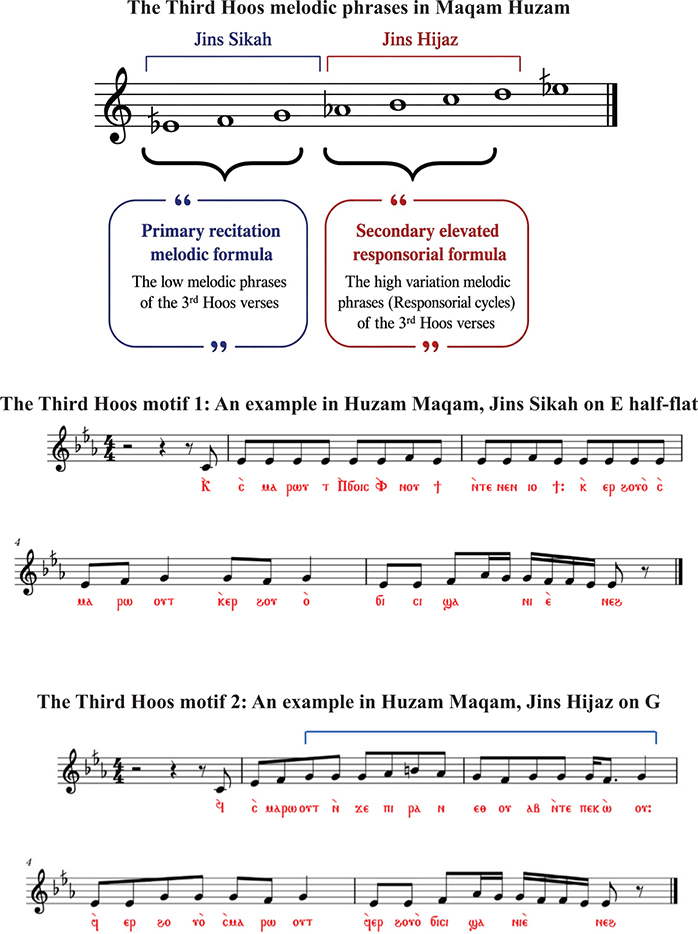
The Third Hoos in the annual Midnight Praise is chanted in a recitation mood and is divided into two musical phrases in Maqam Huzam, which is rooted on E half-flat. It begins with Jins Sikah represented here as a trichord consisting of three notes: E half flat, F, and G. The note G functions as the Ghammaz (pivot) note and marks the begining of Jins Hijaz on G. This also prepares for the subsequent Hos Erof and Ari Hoochasf hymns which employ the Bayati, and Nahawand related ajnas from G. Both Maqam sections are used in the melody: the first verse of the melodic cycle is chanted in the first jins, and the second ascended verse serves as a variation in the second jins. This is a different mode from chanting the same text on the Anastasis Saturday vigil / Apocalypsis when it is chanted in Bayati and in a more joyful spirit. While both ways are about praising God, the Apocalypsis melody reflects the joy of the believers with the first part of the Lord’s salvation which he completed on the cross and burial. The church carries this spirit throughout the rest of the year, in the midnight praises, in a more reserved style of melody, that reflects a thanksgiving praise for the accomplished salvation.
The final two Stanzas of the Hoos are chanted in a unique and elaborate melody that differs significantly from the preceding sections. The first half of these two verses—corresponding to the first two στέχον (sentences or melodic phrases)—is sung in a similar tune. The time signature for these verses begins in 4/4 and later transitions to 2/4. The melody of the penultimate stanza consists of approximately 156 bars. When the starting note begins on G4 in the Bayati maqam, the lowest note is C4 half-sharp  and the highest note is D5
  . The melodic compass therefore spans nine scale degrees. In terms of absolute pitch distance, the interval from C half-sharp 4 to D5 is one octave and 3/4 tone. This unusal wide pitch range exists exclusively in the word ‘erof -erof’ which means Him.
The melody of the second half of the final two verses differs significantly from that of the first. The opening word of the third στέχον—sentence of both stanzas ‘ϩwc—praise’ is chanted softly in the penultimate stanza, as it is addressed to the three youths and Daniel. This gentle delivery reflects the sensitivity of the moment, allowing them to perceive the depth and significance of the word ‘praise’ within the context of their trial in the fiery furnace—a moment that tested their faith. Subsequently comes the word ‘erof -erof’ with significantly higher pitches, by one full octave, again emphasising to whom that praise is addressed. It is then followed by a soft, short melody in ariϩou`o sacf sa ni`eneϩ’ since the words ‘exalt Him’ do not add any significant power to what has already been demonstrated musically in erof -erof. The respective design in the last verse of the Hoos is quite different. The word ‘ϩwc—praise’ is just chanted in two syllables, followed by the sacrifice melody implored on the word erof -erof, perhaps to avoid repetition of the design in the previous stanza and to lay a foundation for the rest of the melody with multiple compositions, which is all on the word erof -erof. This overall design copies the same pattern as `cmou ePsoic—Bless the Lord’ with almost no melisma in `cmou but the whole melody is in ‘ePsoic -The Lord’. In this section most of the melody is on the letter ‘e’.
The hymn of sacrifice sung in ϩwc `erof of the last verse is found in many other hymns; Allhlouia-Alli AlKorban, aki e’’p`'ol'el-Aki Eepkholkhel, pek’qronoc-Pekethronos, tenen -Tenen,…etc. This is followed by unique melodies for ‘ϩwc `erof—Hoos erof’. It then deviates to the melody of the hymn of the censor ‘let my praise arise before you as incense’ ending up at a solo piece with the highest note. This is followed by another shared melody with do[a ci Oqeoc hmon—Dhoxaci Otheos eemon at the beginning of Anastasis Saturday vigil. This hymn gives glory to God. The ‘ϩwc `erof’ of the last stanza of the Third Hoos comprises 266 measures, including cadential phrases and the transitions between the time signature 4/4, 2/2 and 2/4. When sung on the Bayati maqam, the lowest note is D4 to F5, spanning one octave and a minor third.
The last στέχον of the final verse of the Hoos is ariϩou`o sacf sa ni`eneϩ’. This melody comprises 275 bars when performed in a 2/4 time signature. When sung in the Bayati maqam, the lowest note is D4  and the highest is F5
  yielding a range of one full octave and a minor third. ariϩou`o sacf sa ni`eneϩ’ is divided into two musical patterns forming a chorus that is chanted eight times—at the beginning and end of the first half, and again at the beginning and end of the second half, following the articulation of the words ‘ϩou`o sacf’. These two halves are melodically identical, and between the recurring choruses are three ascending musical phrases that vividly depict the meaning of the words ‘exalt Him’ through their gradual upward progression.
The phrase ariϩou`o sacf sa ni`eneϩ’’ appears to be addressing humans, the crown of creation, for the following reasons:
- 1) It is built upon a steady and uninterrupted rhythmic structure, in contrast to other sections of Hoos erof, which are directed toward the rest of creation and are characterised by frequent rhythmic and melodic variations.
- 2) It presents a clearly defined dialogical structure, one that can be easily perceived by any human being.
- 3) It features a distinct melodic form not found in any other Coptic hymn, emphasising the uniqueness of humanity, who was created in the image and likeness of God.